
The AI Leverage Control Framework
A practical method for deciding what AI should carry, what must stay human,
and what needs review before it becomes part of the business.
AI creates leverage.
It can increase speed, output, consistency, reach, and capacity.
But leverage is neutral.
It can multiply clear thinking, strong systems, and customer value.
It can also multiply weak assumptions, generic language, broken workflows, and false confidence.
That is why the real question is not:
What can AI do?
The better question is:
What is AI allowed to carry here?
The AI Leverage Control Framework helps independent operators answer that question before speed, convenience, or automation turns an unclear decision into business infrastructure.
What AI leverage actually means
Leverage is the ability to extend your judgment, expertise, and business capacity through systems without increasing effort, cost, or complexity at the same rate.
Used well, AI can help you:
- Produce useful work faster.
- Reduce repeated manual effort.
- Improve consistency.
- Turn expertise into reusable assets.
- Prepare better decisions.
- Increase revenue capacity.
- Reduce dependence on owner memory.
- Preserve attention for work that still needs a human.
But more output is not the goal.
The purpose of AI leverage is more useful capacity under better control.
That requires three things:
AI Leverage = Capacity × Clarity × Control
Capacity determines how much useful work the business can carry.
Clarity determines whether the business understands the promise, process, or decision underneath the work.
Control determines whether boundaries, review points, and accountability remain intact.
High capacity with low clarity creates more confusion.
High clarity with low capacity creates good thinking that cannot scale.
Capacity and clarity without control create powerful systems with weak oversight.
The advantage comes from holding all three.
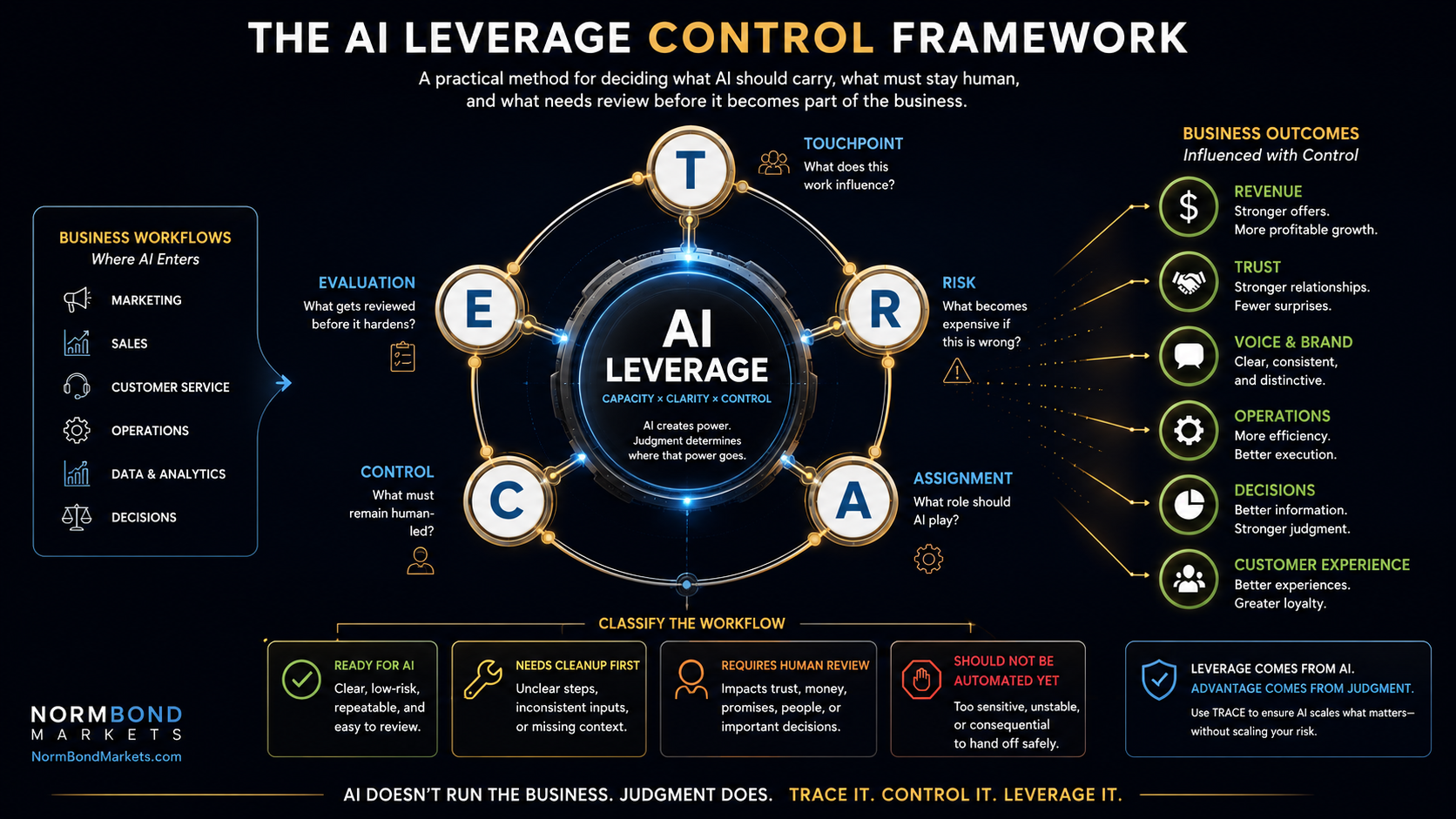
The TRACE Method
TRACE is the practical working method inside the AI Leverage Control Framework.
It helps you classify a workflow before AI begins shaping it.
T: Touchpoint
What does this work influence?
A workflow may look simple while touching something important.
It may influence:
- Revenue.
- Customer trust.
- Delivery quality.
- Compliance.
- Reputation.
- Brand voice.
- Pricing.
- Customer expectations.
- Internal clarity.
- Employee behavior.
- Strategic decisions.
Drafting an internal summary is not the same as answering a refund dispute.
Creating headline options is not the same as recommending a pricing change.
Before using AI, identify what the work is actually carrying.
R: Risk
What becomes expensive if this is wrong?
This is the Expensive If Wrong Test.
Ask:
- Could this create a false promise?
- Could it confuse a customer?
- Could it damage trust?
- Could it expose sensitive information?
- Could it create a bad decision?
- Could it cause refunds, rework, churn, or lost sales?
- Could the mistake repeat across customers, teams, or systems?
- Could it quietly shape future decisions?
The point is not to treat every AI use as dangerous.
The point is to identify consequence before convenience hides it.
The most dangerous AI output is not always obviously bad.
It is often the polished output that looks ready and escapes meaningful review.
A: Assignment
What role should AI play?
AI works better when its assignment is narrow and explicit.
It may act as a:
Drafter
Creates a first version.
Organizer
Turns scattered information into structure.
Summarizer
Condenses calls, notes, documents, or data.
Checker
Looks for missing details, unclear language, or weak assumptions.
Analyst
Compares information and identifies possible patterns.
Coach
Helps prepare for a conversation, objection, or decision.
Operator
Carries a clearly defined recurring task inside a controlled workflow.
The broader the assignment, the more hidden assumptions enter the work.
“Draft three follow-up options” is controlled.
“Handle sales follow-up” gives AI too much undefined authority.
C: Control
What must remain human-led?
AI can carry work.
It cannot carry responsibility.
Human judgment often needs to remain around:
- Final promises.
- Ethical decisions.
- Pricing exceptions.
- Sensitive complaints.
- Customer nuance.
- Relationship moments.
- Legal or compliance judgment.
- High-stakes recommendations.
- Incomplete context.
- Situations where trust matters more than speed.
AI can draft the message.
The business owns the promise.
AI can summarize the meeting.
The business acts on the summary.
AI can suggest the next move.
The operator remains accountable for the decision.
That boundary is not resistance.
It is control.
E: Evaluation
What gets reviewed before it hardens?
Review anything that may become reusable, repeated, delegated, or automated.
That includes:
- Prompts.
- Outputs.
- Templates.
- Automations.
- Standard operating procedures.
- Decision rules.
- Customer-facing language.
- Data assumptions.
- Escalation triggers.
- Reusable workflows.
The word hardens matters.
A weak draft may create one mistake.
A weak draft turned into a template becomes a habit.
A template turned into an automation becomes a system.
A system repeated across customers becomes operational reality.
That is where quiet risk compounds.
TRACE in practice
Marketing
AI can help draft content, repurpose ideas, organize customer language, and compare headlines.
TRACE asks:
What claim is being made?
What happens if that claim is wrong?
Is AI drafting, or quietly deciding the positioning?
What must remain rooted in customer truth and brand judgment?
What gets reviewed before the message repeats across every channel?
Common risk: AI scales generic positioning or unsupported promises.
Sales
AI can summarize calls, prepare follow-ups, organize objections, and draft proposals.
TRACE asks:
What promise is being shaped?
What becomes expensive if the buyer misunderstands?
Is AI preparing options, or deciding what should be offered?
Who owns pricing, fit, scope, and final commitment?
What gets checked before the draft becomes a reusable sales asset?
Common risk: AI helps the business repeat unclear promises faster.
Customer service
AI can draft routine replies, classify requests, organize complaint histories, and build FAQ material.
TRACE asks:
Does this moment require information or attention?
What happens if the tone is technically correct but emotionally wrong?
Is AI drafting a response, or handling the customer?
When must a person step in?
What gets reviewed before automatic replies become the customer experience?
Common risk: The business confuses fast answers with trust-building responses.
Operations
AI can create checklists, draft procedures, summarize handoffs, and organize training material.
TRACE asks:
Is the underlying process actually sound?
What becomes expensive if the workflow leaves out an exception?
Is AI documenting excellence or formalizing a workaround?
Who defines the standard?
What gets tested before the process becomes official?
Common risk: AI turns an old shortcut into a permanent system.
Data and decision support
AI can summarize information, compare scenarios, surface patterns, and generate questions.
TRACE asks:
Is the data reliable?
What happens if the summary sounds more certain than the evidence supports?
Is AI organizing the information, or deciding what it means?
Who interprets the context?
What gets verified before the output shapes a decision?
Common risk: A clean summary becomes false certainty.
Classify the workflow
After applying TRACE, place the workflow into one of four categories.
Ready for AI
The work is clear, low-risk, repeatable, and easy to review.
Needs Cleanup First
The process contains unclear steps, inconsistent inputs, or undocumented assumptions.
Requires Human Review
AI can assist, but the output touches trust, money, promises, people, or important decisions.
Should Not Be Automated Yet
The work is too sensitive, unstable, poorly understood, or consequential to hand off safely.
This classification turns AI use into a judgment process.
Not a tool experiment.
Start with the book
The AI Judgment Advantage
The book introduces the operating philosophy behind the framework.
It shows independent operators how to use AI as a non-human operator without surrendering strategy, trust, voice, or decision-making.
Inside, you will learn how AI creates leverage, why polished output can hide weak judgment, and how to decide what AI can carry, what needs review, and what must stay human-led.
Apply the framework to your business
The AI Judgment Audit Kit
The Audit Kit turns TRACE into a practical self-guided diagnostic.
Use it to:
Inventory where AI is already touching the business.
Apply the Expensive If Wrong Test.
Classify workflows by readiness and risk.
Define AI’s role.
Set human boundaries.
Create a focused 30-day action plan.
This is where the framework moves from concept to application.
Get a personalized interpretation
The AI Judgment Review
Complete the Audit Kit, then submit your work for a focused review.
Norm will examine:
Where AI can safely create leverage now.
Where risk is being underestimated.
Where AI has been given too much authority.
Where the human boundary is unclear.
What should be changed first.
You receive a personalized Loom or video response with a prioritized 30-day recommendation.
This is not a general AI consultation.
It is a judgment review.
The larger point
AI should not touch important work without classification.
Before the workflow becomes faster, reusable, or automated, TRACE what it influences, what becomes expensive if it is wrong, what role AI should play, what must stay human, and what needs review before it hardens.
That is how independent operators turn AI leverage into revenue, trust, and control.