

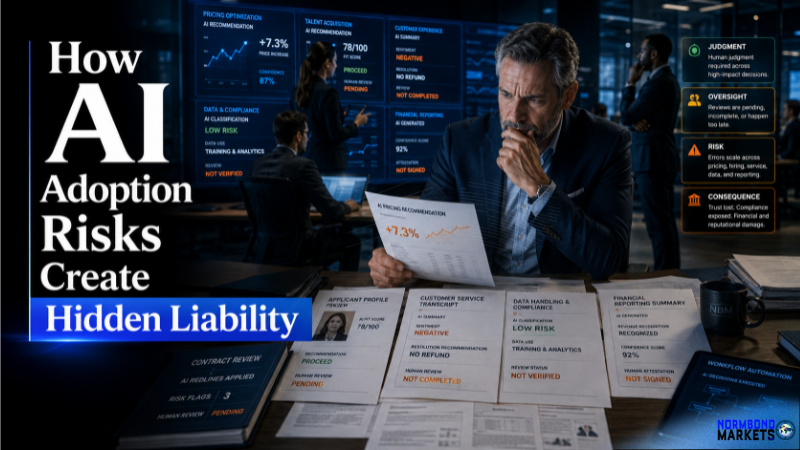

AI adoption risks begin when a system influences business decisions without clear human judgment.
AI does not need to fail publicly to damage your company. It only needs to repeat one unchecked decision.
That decision may shape pricing, hiring, customer service, or financial reporting. The output may appear reasonable while its hidden assumptions spread across the company.
By the time leaders notice, the decision may already define daily operations.
That is the real danger behind careless AI adoption. The technology creates speed before the company establishes shared judgment.
Speed then multiplies choices nobody clearly reviewed, approved, or understood.
Let me speak to the executive most likely to reject that warning.
You have heard endless AI predictions.
Vendors promised transformation before they understood your operating reality. Consultants inflated small risks to justify large governance projects. Employees resisted useful tools by raising vague ethical concerns.
You have seen fear become another form of corporate theater.
Your doubt makes sense.
However, this argument does not depend on fear or distant scenarios. It depends on ordinary business logic.
Every company remains accountable for decisions made through its systems. AI changes how quickly those decisions spread across the organization.
It does not transfer responsibility away from leadership.
That gap creates hidden liability.
What are the main risks of AI adoption?
AI adoption risks arise when systems shape decisions, promises, data use, employee skills, or customer outcomes without clear ownership. The greatest risks include repeated errors, weak human review, privacy exposure, misleading claims, hidden vendor dependence, capability loss, and unclear accountability across departments.
How AI Systems Influence Business Decisions
Most companies describe AI as a tool that supports employees.
That description sounds safe because tools appear passive and controlled. Yet modern AI systems do more than improve individual productivity.
They summarize evidence, rank options, recommend actions, and draft communications. They also determine what employees notice and what they overlook.
That means AI quietly shapes the frame surrounding each decision.
Consider a customer service agent handling a disputed refund.
The AI summarizes the customer’s history and recommends rejecting payment. The employee sees a polished answer backed by several confident reasons.
They approve the recommendation because nothing appears obviously wrong.
However, the summary omitted a previous promise made by another representative. The company now breaks its own commitment without knowing why.
One mistake may create a complaint.
Ten thousand similar mistakes create a business practice.
That distinction matters.
Liability rarely begins with one dramatic system failure. It begins when repeated outputs become normal operating behavior.
AI makes that repetition cheap, fast, and difficult to observe.
The company believes employees still control each decision. In practice, the AI controls what those employees see first.
That position gives the system enormous influence without formal authority.
Leadership delegated judgment without acknowledging that delegation. Responsibility remained with the company.
That is hidden liability.
Why AI Output Can Look More Reliable Than It Is
Weak AI output does not usually resemble obvious system failure.
It arrives through clean sentences, organized tables, and confident recommendations. That presentation causes people to overestimate its reliability.
A rough answer invites inspection.
A polished answer invites acceptance.
This difference makes generative AI dangerous inside rushed organizations.
The system can express uncertain claims using calm, precise language. Employees often read confidence as evidence of careful reasoning.
Yet language models generate probable language. They do not verify business truth.
NIST identifies false content, privacy exposure, bias, security threats, and automation risks. Its AI Risk Management Framework also stresses testing, monitoring, accountability, and documented oversight.
These controls exist because useful systems still produce harmful outcomes.
A model can perform well overall and fail badly somewhere important.
Average performance does not protect a company from specific damage.
Customers experience individual decisions, not benchmark averages. Regulators examine actual conduct, not impressive demonstrations. Employees act on specific recommendations, not performance scores.
The dangerous question is not whether the AI works.
The dangerous question is where leaders assume it works without proof.
Most AI adoption programs never answer that question clearly.
They test whether employees can use the system. They do not test whether employees should trust each output.
That confusion turns usability testing into false assurance.
A system can feel easy while creating severe operational exposure.
How AI Automation Scales Business Errors
Human mistakes usually face natural limits.
One employee can only write, review, or approve so much. AI removes many of those limits.
A flawed message can reach thousands of customers immediately. An incorrect rule can influence every application, claim, or support ticket.
A biased assumption can shape hiring across several departments. An invented citation can enter reports, presentations, and board materials.
The original mistake may remain small.
The distribution system makes the consequences large.
This is why AI risk differs from ordinary employee error.
AI compresses the distance between one assumption and widespread execution.
Imagine a sales team using AI-generated account research.
The system wrongly labels a prospect as facing regulatory pressure. A representative builds the entire pitch around that false claim.
The prospect loses trust and questions the company’s professional standards.
Now imagine that workflow running across five thousand target accounts.
The problem was not merely inaccurate writing.
The problem was unmanaged interpretation operating at scale.
Executives often focus on whether someone reviews the final output.
That safeguard sounds stronger than it is.
Human review weakens when volume rises and deadlines tighten. Employees stop investigating each answer.
They scan for obvious defects instead.
A believable mistake can survive that review easily.
The employee remains formally responsible but loses practical control. The company keeps the appearance of oversight without the substance.
Why Companies Remain Liable for AI-Generated Claims
Customers do not care whether a chatbot invented the wrong answer.
They believe the chatbot represents the business.
Investors treat company statements as company statements. Regulators evaluate claims, conduct, and resulting harm.
They do not excuse deception because software produced the language.
The Federal Trade Commission has already acted against unsupported AI claims.
Its action against DoNotPay required monetary relief and restricted misleading claims about the service’s performance.
The Securities and Exchange Commission has reached the same basic conclusion.
Companies cannot make false claims about their AI systems or capabilities.
Two investment advisers paid combined penalties after making misleading AI-related statements. Another enforcement case involved false claims about automated trading.
The SEC also charged the founder of Nate after investors received misleading claims about the company’s technology. The company reportedly raised more than $42 million during that period.
These cases reveal something larger than individual enforcement actions.
AI adoption creates new claims about competence, accuracy, and automation.
Those claims may appear in marketing, contracts, reports, sales materials, and investor communications.
Each claim creates an expectation the organization must support.
The company must understand what the system actually does. It must also understand where human labor remains hidden.
Presto faced SEC action over statements describing its voice technology. The company failed to disclose important third-party involvement behind deployments.
This exposes another source of AI hidden liability.
AI can obscure who performs the work and who controls the system.
Executives may believe they purchased automated capability. Instead, they may depend on vendors, contractors, or hidden human reviewers.
That dependence affects cost, privacy, resilience, and truthful disclosure.
An unclear operating model can become a misleading external story.
How Generative AI Creates Data Privacy Risks
Many AI risks do not require malicious employees or skilled hackers.
They happen when responsible employees try to complete ordinary assignments.
A manager uploads customer records for faster analysis. A recruiter pastes applicant details into an external model.
A lawyer asks AI to summarize confidential contract terms. A marketer uploads private strategy documents for campaign ideas.
Each action appears productive.
Together, they create an undocumented data transfer system.
The company may not know which information left approved environments. It may not understand how vendors store or process that information.
It may not know which contractual protections apply.
The FTC has warned companies about privacy and confidentiality commitments. Missing facts can create misleading impressions about how a company handles data.
This exposure becomes worse through shadow AI adoption.
Employees rarely wait for formal programs when useful tools appear. They create personal accounts and develop their own workflows.
Those workflows may become essential before leadership notices them.
A hidden system may shape revenue work, hiring, or customer communication. Nobody documented its prompts, inputs, permissions, or review process.
Removing the tool later can disrupt operations.
Keeping it can preserve unknown exposure.
Leadership now faces a choice created by unmanaged employee behavior.
That choice never appeared on an executive agenda. Yet it may affect customer trust, privacy duties, and contractual obligations.
Hidden liability often enters through convenience, not reckless intent.
How AI Efficiency Can Weaken Employee Skills
AI often produces immediate efficiency gains.
Employees write faster, summarize faster, and research faster.
Those benefits are real.
They can also hide a loss of internal capability.
Consider a junior analyst who relies on AI summaries every day.
The analyst completes more assignments with less direct source review. Managers see higher output and reward the productivity gain.
Over time, the analyst stops building strong research judgment.
- The company gains faster documents but loses stronger analysts.
- That trade remains invisible until the AI produces a serious mistake.
- Then leaders discover that nobody can inspect the underlying reasoning quickly.
This pattern affects more than junior employees.
Executives can also lose direct contact with weak signals.
AI summaries remove detail to create speed. Yet important contradictions often live inside those discarded details.
A concise report may improve meeting flow.
It may also erase the tension leaders needed to examine.
The system does not merely save executive attention. It helps decide which evidence receives that attention.
Someone must judge those filtering choices.
Otherwise, the company outsources perception before it outsources decisions.
That creates strategic liability.
Leaders cannot challenge assumptions they never encounter. They cannot notice drift hidden inside clean executive summaries.
They cannot govern consequences after losing contact with their causes.
Who Owns Accountability for AI Decisions?
AI adoption usually crosses several departments.
Technology teams select tools and manage system access. Legal reviews contracts and external obligations.
Security protects data and infrastructure. Business teams design daily workflows.
Employees interpret outputs and make final decisions.
This structure appears distributed.
In practice, it often means nobody owns the complete decision chain.
Technology owns the platform but not the business outcome. Legal owns policy but not daily employee behavior.
Managers own results but may not understand model limits. Employees own approvals but did not design the workflow.
Each group assumes another group inspected the critical risk.
That assumption survives until something goes wrong.
Then responsibility moves backward through the organization.
The company discovers several approvals but no accountable owner.
This is not merely a policy gap.
It is an ownership gap.
Policies describe what employees should avoid. Judgment defines who decides when conditions become unclear.
AI creates unclear conditions constantly.
Outputs change with prompts, context, models, data, and settings. A process that worked last month may behave differently after a model update.
Static approval cannot govern a changing decision environment.
Organizations need named owners for specific AI-mediated outcomes. They also need clear limits around acceptable system authority.
Without those limits, influence expands through repeated convenience.
The system gains practical authority without receiving formal accountability.
That imbalance creates liability before any visible incident occurs.
Why Successful AI Adoption Can Still Create Risk
The strongest objection usually sounds reasonable.
“Our AI program works, and nothing serious has happened.”
That statement does not prove the program is safe.
It may only mean the consequences remain delayed, hidden, or spread across several teams.
- Customers may silently leave after receiving weak automated service. Employees may correct AI errors without reporting them.
- Managers may absorb extra review work outside official measures. Vendors may hide system limits behind service agreements.
- Teams may avoid unusual cases the workflow cannot handle.
- Reported productivity then rises while hidden labor rises beside it.
Successful AI adoption can therefore mask structural weakness.
The organization celebrates faster output.
It does not measure correction time, exception handling, or trust loss.
It tracks usage because usage is easy to count.
It ignores judgment quality because judgment is harder to measure.
That choice creates a misleading scorecard.
The company learns how much AI activity occurred. It does not learn whether decisions improved.
This is where execution outruns shared understanding.
Leaders see movement and assume the system gained maturity. Employees see uncertainty but assume leadership accepted the risks.
Vendors see continued use and assume the product proved itself.
Everyone reads the same activity through different assumptions.
Those assumptions harden because the workflow keeps moving.
Nothing needs to break dramatically.
The organization can become fragile while appearing more efficient.
How AI Governance Reduces Hidden Liability
AI judgment does not mean slowing every decision.
It means defining what the company refuses to automate blindly.
Leaders must identify outputs that can create meaningful obligations. They must locate decisions affecting money, rights, access, and trust.
- They must separate low-cost errors from high-consequence errors.
- They must define where human review can actually change an outcome.
- They must also decide when employees should reject system recommendations.
These choices cannot remain buried inside technical settings.
They express the company’s operating values and risk appetite.
That makes them executive decisions.
NIST’s AI Risk Management Framework organizes risk work through governance, mapping, measurement, and management.
Those functions require continuous action, not one-time approval.
The practical questions remain direct:
What business decisions does this AI influence?
Which evidence can the system omit?
Who verifies claims before they spread?
Where can employees challenge the output?
What data enters external systems?
Which vendor dependencies remain hidden?
Who owns failures across departmental boundaries?
What happens when the model changes?
Which customers carry the greatest error costs?
What evidence proves the workflow improves decisions?
These questions do not block AI adoption.
They prevent adoption from creating obligations nobody understands.
A strong AI governance program does not remove human judgment.
It places human judgment where consequences become difficult to reverse.
That placement protects speed instead of opposing it.
Teams can move faster because the boundaries remain clear.
Executives can approve scale because accountability remains visible.
Employees understand when assistance becomes unauthorized delegation.
Customers receive service backed by an accountable institution.
How to Identify AI Adoption Risks Before They Scale
Companies will continue adopting AI.
The economic pressure remains too strong for retreat.
However, adoption alone does not create durable advantage. Competitors can purchase the same models and similar tools.
The advantage comes from governing what those systems influence.
Organizations with stronger AI judgment will detect weak assumptions earlier. They will scale reliable workflows without scaling every mistake.
They will preserve customer trust during rapid operational change. They will know which decisions require accountable human review.
Others will confuse activity with capability.
They will add AI wherever teams encounter friction. Each tool will solve a local problem.
Together, those tools will create an unowned decision system.
That system will shape promises, access, prices, customer treatment, and internal priorities.
Executives will remain responsible for consequences they never clearly authorized.
That is the central problem behind AI adoption risks.
Hidden liability does not appear only when AI adoption fails. It accumulates while adoption appears successful.
The question is not whether your company uses AI.
The question is what AI already influences without clear judgment.
Map those decisions. Name their owners. Test their assumptions. Define their limits.
Do it before convenience hardens into operating reality.

Norm Bond
Latest posts by Norm Bond (see all)
- The Transfer of Judgment: When AI Shapes the Decision Before the Human Makes It - October 4, 2026
- Your AI Adoption May Be Moving Faster Than Your Ability to Inspect It - September 21, 2026
- How AI Adoption Risks Create Hidden Liability - July 19, 2026
