We work with leaders when execution is moving faster than shared understanding.
Our role is to surface interpretive risk early. Before momentum hardens assumptions, decisions lock in, and course correction becomes expensive.
This is not marketing or growth consulting.
It’s judgment, applied upstream.
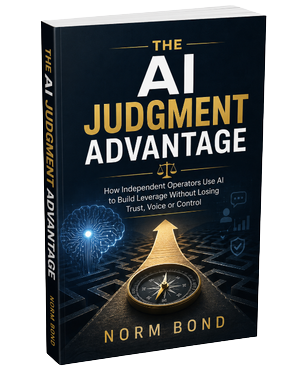
NormBondMarkets helps independent operators and AI-native companies use AI, scale, and execution without surrendering judgment, trust, or control. become risky.
Independent operators using AI inside a trust-based business
AI is already touching your marketing, sales, service, operations, data, workflows, and decisions. Start here if you need to know what AI can carry, what needs review, and what must stay human-led.
The Interpretation Gap™ Diagnostic helps AI-native companies uncover where meaning, context or alignment breaks inside the system — before it becomes loss.
Often, this happens precisely because things are working.
But shared understanding does not compound at the same rate.
When capability outpaces comprehension, teams don’t break loudly. They drift quietly.
Signals conflict. Confidence fragments. Execution continues, but risk becomes harder to see.
This is where momentum turns fragile. And why the most expensive mistakes aren’t execution failures, but problem-classification failures.
This work exists upstream of execution.
Most teams assume they have an execution problem. Many actually have an interpretation problem upstream.
Accelerating the wrong thing doesn’t fix uncertainty. It amplifies it. The goal is not to slow decisions. It is to decide from the correct problem frame.
The purpose of this work is to resolve that distinction before cost, narrative, valuation, or trust are accidentally locked in.
How This Shows Up First
Interpretation failures rarely announce themselves. They show up first in small, reasonable decisions that quietly shape what the system treats as fixed.
Decision
At the decision layer, problems don’t appear as mistakes.
They appear as confidence.
Early framing turns into commitment. Options narrow without being named. Execution improves — even as reversibility disappears.
Nothing breaks. But future choices quietly get more expensive.
This is often where systems begin answering the wrong question, very efficiently.
Product
At the product layer, interpretation hardens into structure.
Language becomes an interface. Roadmaps optimize for compatibility. Features ship faster — while flexibility quietly collapses.
The product improves. The system narrows.
By the time this feels strategic, the constraint has already traveled.
Where This Eventually Shows Up
When interpretation quietly drifts upstream, the effects don’t stay local.
They accumulate.
Over time, what begins as a small misread shapes direction, constrains optionality and alters how the market responds. Often without a single visible failure along the way.
Strategy
Strategy is where early understanding becomes long-term direction.
When meaning hardens before learning stabilizes, strategy can feel clear while quietly losing flexibility.
Not because it’s wrong. But because it stopped being questioned.
Market
Markets respond to signals, not intent.
When internal performance improves but meaning stops translating, confidence can soften without an obvious cause.
The system hasn’t stalled. Belief just isn’t compounding.
These layers don’t fail first.
They reflect what has already been set in motion elsewhere.
How the work unfolds
Interpretation Gap™ Diagnostic
A short, focused judgment intervention that determines whether stalled momentum is caused by an execution constraint or an interpretation failure upstream.
If — and only if — execution is confirmed as the true constraint, visibility and narrative systems may be introduced downstream.
Execution is a consequence of clarity, not a substitute for it.
Why this work exists
Across years of work in markets, publishing and technology, the pattern is consistent:
Capability compounds faster than shared meaning. And misclassification costs more than delay.
My writing and thinking on this has appeared on platforms such as HackerNoon, The Startup, and other systems-level publications. Not as commentary, but as an attempt to name a failure mode before it becomes visible.
As Seen On
If you are facing a decision where "getting it wrong" would be expensive or irreversible start with classification — not momentum.