

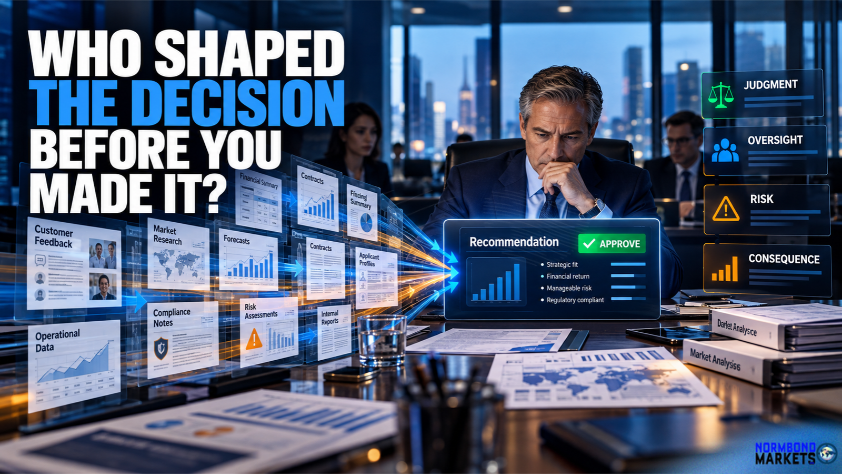

Companies are no longer waiting to find out whether AI can do useful work.
It already can.
AI is writing.
Summarizing.
Forecasting.
Ranking.
Analyzing.
Recommending.
And increasingly, it is being placed inside the everyday work that leads to a business decision.
That changes the question.
The next phase of AI adoption is not about giving AI more work.
It is about deciding how much of the judgment system AI should be allowed to shape.
That distinction matters because the person making the final decision may still be human.
But the decision they receive may already have been shaped long before it reaches them.
AI is already inside the work
A useful signal comes from the October 2026 Wharton Human-AI Research and GBK Collective report, The Adaptive Advantage: Who’s Winning with AI and How.
The report found that 73% of managers and above said AI was fully or substantially embedded in their department’s core processes and workflows.
Twenty-eight percent described it as fully embedded.
The report also found a deeper change in the work itself.
Seventy-two percent of managers and above said their focus had shifted from creating outputs to managing AI-generated outputs. Among vice presidents and above, that rose to 82%.
And 78% of managers and above reported using AI for data analysis or decision support, including things such as summaries, forecasts, and reports.
Those numbers point to something more important than adoption.
They show a change in the human job.
The person who once built the analysis may now review it.
The person who once assembled the evidence may now receive the summary.
The person who once worked through the reasoning may now be asked to approve the recommendation.
That can be efficient.
It can also change what the human still knows.
Once human work shifts from creating to reviewing, the quality of the business decision depends on what the reviewer can still see and challenge.
That is where AI Judgment begins to matter.
Not because AI is automatically wrong.
And not because people need to return to doing everything manually.
The problem is quieter.
A human can remain in the process while losing visibility into how the answer took shape.
The final decision can still be human while the decision has already been shaped
Consider what happens before an executive sees a recommendation.
There may be hundreds of inputs.
- Customer comments.
- Market data.
- Internal reports.
- Historical results.
- Forecasts.
- Risk signals.
- Research.
AI can help turn all of that into something usable.
But every act of compression changes the decision surface.
Something gets included.
Something gets left out.
Something gets ranked higher.
Something gets described as important.
Something becomes the recommended action.
By the time the executive sees the final page, the visible decision may be:
Approve.
Reject.
Continue.
Stop.
Invest.
Hire.
Change direction.
The button is human.
The preparation may not be.
AI does not need final authority to shape the decision. It only needs enough influence over what the human sees first.
That is the hidden handoff.
And it is becoming easier to miss as AI becomes more useful.
AI is moving closer to the decision
A second October 2026 signal comes from the Thinking Ahead Institute and MSCI Institute study of large asset owners.
Sixty-five percent of the asset owners studied said AI was integral to their long-term plans.
Yet only 25% had AI as a standing board or investment-committee agenda item.
That gap is worth paying attention to.
The study describes AI, data platforms, and analytics moving deeper into research, monitoring, portfolio insight, and decision preparation.
It also makes clear that human judgment, accountability, interpretation, and oversight remain necessary.
One of its more important observations is about decision rights.
Someone still needs to decide when AI can recommend.
When it can act.
When a matter must move to a human.
When a human can override it.
And when human veto must remain mandatory.
That is not a software setting.
It is a business decision about where responsibility sits.
The study also reports that oversight quality increasingly depends on whether people have enough expertise to challenge models, interpret outputs, and know when to override or defer.
This is where a common assumption starts to weaken.
We often treat human approval as evidence that human judgment remains intact.
Those are not the same thing.
A person can approve something they did not meaningfully examine.
A person can review a recommendation without seeing what was discarded.
A person can sign off on an answer without being able to reconstruct how the answer was formed.
And once a business begins building workflows, customer promises, forecasts, or operating decisions around that process, the handoff starts to harden.
You will not necessarily notice the commitment.
You may call it efficiency.
“Human in the loop” is not enough
The third signal comes from the Financial Stability Board.
Its October 15, 2026 final report on responsible AI adoption in financial services makes an important point: human involvement does not automatically produce effective oversight.
That sounds obvious until you look at how many AI processes are defended with four words:
A human reviews it.
But what does review actually mean?
- Does the person have access to the original evidence?
- Can they see the assumptions?
- Do they know what the model left out?
- Do they have the authority to stop the process?
- Do they have enough skill to challenge the result?
- Do they have enough time?
And will the organization support them if they disagree with the machine-generated recommendation?
The FSB warns about over-reliance and automation bias.
It also makes clear that organizations remain accountable for AI-related outcomes, including when third-party systems and services are involved.
That creates a hard boundary.
The software can produce the output.
The business still owns the outcome.
So the useful question is not:
Is a human in the loop?
It is:
Does that human still have enough evidence, authority, context, skill, and time to make a defensible judgment?
That is a much higher bar.
The handoff usually happens before anyone calls it a handoff
AI influence rarely arrives all at once.
It moves through the work.
Evidence becomes a summary.
The summary becomes a recommendation.
The recommendation enters a workflow.
The workflow influences a decision.
The decision becomes a commitment.
Each step can look reasonable on its own.
That is why the transfer is hard to see.
AI may not be deciding whether to hire someone.
It may be ranking the candidates.
AI may not be approving a customer offer.
It may be recommending what should be offered.
AI may not be making an investment decision.
It may be deciding which signals deserve attention.
AI may not be setting the forecast.
It may be compressing the evidence the forecast is built on.
AI may not be writing board policy.
It may be producing the summary the board discusses.
The final decision remains human.
But more of the path toward that decision may already belong to the machine.
AI can carry work. It cannot carry consequence.
That distinction becomes more important as AI moves closer to decisions the company may later have to explain.
Why this matters commercially
This is not only a compliance problem.
It becomes a commercial problem when an AI-shaped interpretation reaches something the business cannot easily unwind.
A customer recommendation.
A sales promise.
A hiring decision.
A pricing move.
A forecast.
A capital allocation.
An investor narrative.
A board summary.
An operating standard.
At that point, the question is not whether AI saved time.
The question is what happens if the interpretation was wrong.
Perhaps margin disappears.
Perhaps the sales team starts promising something operations cannot deliver.
Perhaps a customer leaves.
Perhaps the wrong hiring profile becomes the standard.
Perhaps capital moves toward the wrong assumption.
Perhaps management starts defending a forecast that was built on compressed evidence nobody has gone back to inspect.
The original AI output may have taken seconds.
The commitment built around it may last for years.
That is why one question matters more than another feature comparison or productivity metric:
What becomes expensive if this interpretation is wrong?
That question changes where you look.
The part of AI adoption that is harder to measure
Companies are getting better at measuring AI use.
Number of users.
Number of agents.
Hours saved.
Tasks automated.
Costs reduced.
Outputs generated.
Those numbers matter.
But they tell you very little about judgment transfer.
They do not show where interpretation entered the process.
They do not show what disappeared during compression.
They do not show when a recommendation became the default.
And they do not show whether the person making the final call could still challenge the reasoning underneath it.
This is the gap AI Judgment is meant to inspect.
AI Judgment is the inspection layer between AI capability and human accountability.
The point is not to stop AI from carrying more work.
The point is to remain clear about what it is carrying.
Especially when the business still has to defend what happens next.
Four questions worth asking before more gets automated
You do not need to inspect every AI output with the same intensity.
But when an AI-generated summary, recommendation, ranking, forecast, or draft is about to influence a real commitment, four questions become useful:
- What part of this output is evidence, and what part is interpretation?
- What disappeared during compression or automation?
- What decision or commitment will this influence next?
- Who still gets to make the final call, and can that person actually challenge what they received?
The questions are simple.
The answers often are not.
That is the point.
The goal is not to prove the AI is wrong.
It is to find out what the organization is already depending on before that dependence becomes harder to unwind.
Before you automate more, inspect what you already handed over
None of these three research reports proves that AI-shaped decisions are broadly failing.
That would be too large a claim.
What they do show is something more immediate.
AI is becoming embedded in real work.
It is moving into analysis and decision preparation.
Humans are spending more time reviewing AI-generated output.
And organizations are being forced to think harder about oversight, decision rights, challenge, escalation, and accountability.
Those conditions are enough to create a new question.
Not:
How much more can AI do?
But:
How much of the judgment system should AI be allowed to shape before the business loses visibility into what it still has to defend?
AI adoption is getting easier to measure.
Judgment transfer is not.
A company can still require human approval and quietly lose sight of where the recommendation was formed.
That is the part that gets defended later.
Before you automate more, inspect what you already handed over.
If AI is already summarizing, ranking, recommending, drafting, forecasting, or preparing decisions inside your business, the AI Judgment Scorecard is a useful place to inspect what AI may already be carrying.
And if AI-shaped interpretation is already influencing leadership decisions, customer commitments, investor narratives, or other outcomes the business may have to defend, the issue has moved beyond simple inspection.
That is where the Interpretation Gap Pre-Diagnostic belongs.

Norm Bond
Latest posts by Norm Bond (see all)
- How Much of the Judgment System Should AI Be Allowed to Shape? - October 16, 2026
- The Transfer of Judgment: When AI Shapes the Decision Before the Human Makes It - October 4, 2026
- Your AI Adoption May Be Moving Faster Than Your Ability to Inspect It - September 21, 2026
