
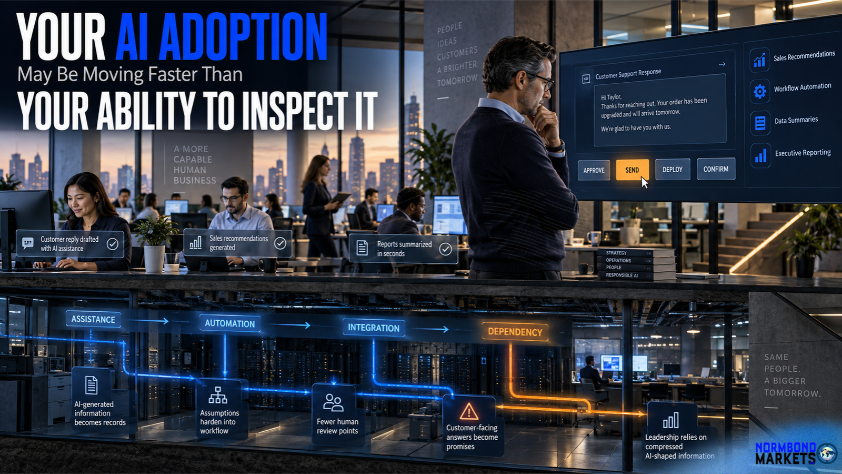

AI keeps getting more capable. The business question is not only how quickly you can adopt it. It is whether your ability to inspect what AI is carrying is keeping pace.
Some of the people building increasingly capable AI are asking a harder question about speed.
In a September 2026 essay, Dario Amodei co-founder and CEO of Anthropic, the AI company behind Claude talked about why the AI industry should slow down.
He argued that frontier AI capability should not advance faster than the mechanisms needed to understand, evaluate, and control increasingly powerful systems.
You do not need to agree with every part of that argument to notice the tension underneath it.
Capability can move faster than our ability to inspect what that capability is doing.
Business leaders have their own version of the same problem.
You may not control how quickly the frontier moves.
You do control how quickly new capability enters your business.
And that is where the conversation changes.
The business version of the pacing problem
Most companies are asking reasonable questions about AI.
What can this model do?
Where can we deploy it?
What can we automate?
How much time can it save?
How many people need to touch the work?
Those are useful questions.
But they can move adoption faster than judgment.
A better operating rule is:
Do not increase what AI is allowed to carry faster than your ability to inspect the consequence.
That is not an argument for moving slowly.
A low-consequence task can move quickly.
Drafting internal notes is not the same as setting a price.
Organizing research is not the same as deciding which customer gets approved.
Preparing a response is not the same as making a promise.
Summarizing a meeting is not the same as creating the record leadership will act from.
The issue is not speed by itself.
It is speed relative to consequence.
The closer AI gets to promises, decisions, records, money, policy, customer relationships, or leadership judgment, the more important inspection becomes.
You need to know what AI may do.
You need to know what evidence is required before the business acts.
You need to know where a person still has to review, approve, question, or stop the work.
And you need to know who owns the outcome.
That gets harder as AI improves.
Not because the technology becomes less useful.
Because usefulness changes what the business is willing to hand over.
AI usually enters as assistance
Most AI adoption does not begin with a major company decision.
It begins with relief.
Draft this.
Summarize that.
Recommend the next step.
Classify these leads.
Answer that customer.
Organize this information.
Turn these notes into something usable.
The first handoff often feels light.
Then the system works.
So you use it again.
The draft gets less review.
The recommendation becomes the starting point.
The summary becomes the record.
The answer becomes what the customer hears from the company.
The workaround becomes the workflow.
The workflow becomes expected.
Nothing dramatic has to happen.
That is what makes the shift easy to miss.
Every time capability expands faster than inspection, yesterday’s experiment has another chance to become tomorrow’s operating assumption.
You may still think you are using the same tool for the same task.
But the task may already be carrying more weight than it did when you first approved it.
Touch is not the same as carrying
A useful first question is:
What should this tool be allowed to touch?
That matters when AI first enters the business.
But after the system has been operating for a while, another question becomes more important:
What is it carrying now?
Those are not the same thing.
A draft can become a promise.
A summary can become the record.
A recommendation can become the frame through which you see the decision.
A shortcut can become the workflow.
A customer response can become the company’s treatment of the relationship.
Data can become interpretation.
AI does not need final authority to shape a decision.
It can influence the options you see.
The evidence you consider.
The recommendation that reaches you first.
The facts that get summarized.
The uncertainty that disappears.
The confidence that forms around an answer.
You may still make the final call.
But the path to that call may already have been shaped before it reached you.
That is why saying “a human still approves it” is not always enough.
The more useful question is:
What reached the human before approval?
The status update that became a promise
Take an ordinary customer-service example.
A customer asks when a replacement auto part will arrive.
The company’s AI says Wednesday.
Later, a human employee checks and says the following Tuesday.
From the company’s point of view, the problem may look like inaccurate information.
From the customer’s point of view, something else happened.
The business told her Wednesday.
She made plans around Wednesday.
Then the answer changed.
The business thought AI was giving a status update.
The customer experienced it as a promise.
The AI carried information.
But the information created an expectation.
The expectation belonged to the company.
And when the expectation broke, the relationship consequence returned to a human.
Your customer does not have a relationship with your AI.
They have a relationship with your business.
The software may produce the answer.
Your business still owns what the answer causes.
That is the part worth inspecting.
Success can make inspection harder
Most discussions about AI risk focus on failure.
But failure has one useful property.
People notice it.
A bad answer gets questioned.
A broken workflow gets escalated.
A strange recommendation attracts attention.
Success behaves differently.
Success gets repeated.
If an AI workflow saves time, reduces cost, increases throughput, responds faster, or allows fewer people to touch the work, you have reasons to expand it.
Then other decisions begin forming around that success.
Staffing assumptions.
Response-time expectations.
Customer promises.
Sales language.
Processes.
Metrics.
Revenue expectations.
Management habits.
Support capacity.
Hiring plans.
What started as an experiment begins carrying weight.
This is where you can become more committed than you realize.
AI answering support tickets is one thing.
Reducing support capacity because you now expect AI to keep absorbing the volume is another.
AI generating code is one thing.
Building a release schedule or customer promise around that pace is another.
AI producing summaries is one thing.
Making leadership decisions from records nobody can fully reconstruct is another.
That is the change to watch.
Success can harden AI into the business faster than failure ever could.
The more value you build around an AI workflow, the more expensive it becomes to question the assumptions inside it.
That is why inspection should grow with dependence.
Not after dependence becomes obvious.
While it is forming.
The company can change before the label does
You may still describe an AI system as assistive.
But customer expectations may already depend on it.
You may still call the workflow experimental.
But the hiring plan may already assume it will hold.
The product may still be called a pilot.
But sales may already be making promises around it.
Your policy may still say human reviewed.
But the volume may already make meaningful review difficult.
You may still believe you are testing the AI.
The business around it may already be adjusting.
At first, the question is:
Where is AI touching the business?
Then:
What is it carrying?
But once you start building around that behavior, another question appears:
Has the organization built around AI faster than leadership has interpreted what AI has become inside the business?
That is what I mean by the Interpretation Gap™.
The problem is not necessarily that AI is failing.
The problem is that its role may have changed before your language changed.
You still call it an assistant.
Your service levels depend on it.
You still call it a pilot.
Your customers expect it.
You still call it a recommendation.
Your team treats it as the starting point.
You still call it a summary.
Leadership acts from it.
The label stayed the same.
The role changed.
Once hiring, customer commitments, roadmaps, revenue assumptions, or operating capacity depend on that changed role, you are no longer examining a simple tool choice.
You are examining a commitment.
A human in the loop is not enough
One common response is simple:
Keep a human involved.
That sounds right.
But it is incomplete.
A person can be present without carrying much authority.
So ask:
Who still gets to make the final call?
Then go further.
Who can override the system?
Who can stop it?
Who notices when the situation has moved from routine to consequential?
Who can question the recommendation instead of simply approving it?
Who repairs the relationship when a technically completed workflow did not actually solve the customer problem?
Who owns the outcome?
Responsibility and authority have to stay connected.
If you are responsible for the result but cannot meaningfully inspect, challenge, override, or stop what AI is carrying, you have kept accountability while giving away part of the control.
The business still has to defend the result.
A practical pacing test
Before you expand an AI workflow, inspect what has already happened.
Ask:
- What is AI touching?
- What has it started carrying?
- What decisions are hidden inside that work?
- What are we beginning to build around its output?
- Who still gets to make the final call?
- What becomes expensive if this is wrong?
Then ask the pacing question:
Is our ability to inspect this workflow increasing as quickly as our willingness to depend on it?
That does not require slowing everything down.
It requires matching inspection to consequence.
Some AI work can move quickly because the cost of being wrong is small and easy to reverse.
Other work deserves more scrutiny because you are making promises, shaping decisions, creating records, interpreting evidence, setting prices, allocating resources, or affecting people who may never know an AI system influenced the outcome.
The closer the work gets to consequence, the more inspection matters.
The frontier will keep moving
More capable models are coming.
More autonomous systems are coming.
Businesses will keep finding new work AI can perform.
That is not a temporary condition.
It is the environment you are operating in.
The durable advantage will not come from pretending that expansion can be stopped.
It will not come from refusing useful capability.
And it will not come from handing over every task simply because the technology has become capable of doing it.
Every increase in AI capability expands the work it can touch.
That does not automatically expand the work it should be trusted to carry.
The distance between those two decisions is where AI Judgment belongs.
Frontier developers have to decide how responsibly to develop increasingly capable AI.
You have another question:
How do you responsibly absorb increasingly capable AI?
That is the question inside your company.
And it gets more important every time the technology improves.
Inspect before you automate more
You do not need to stop using AI to inspect what it has become inside your business.
Start with the work already happening.
Where is AI touching sales, marketing, service, operations, or data?
What was it originally allowed to do?
What is it carrying now?
What have you started building around that output?
And who still gets to make the final call?
Inspect before you automate more.
The AI Judgment Scorecard is a free self-inspection designed to help you identify where AI may already be carrying more work, influence, trust, or consequence than you originally intended.
Because your next AI decision may not be whether to adopt something new.
It may be whether you still understand what the AI you already adopted has become.

Norm Bond
Latest posts by Norm Bond (see all)
- The Transfer of Judgment: When AI Shapes the Decision Before the Human Makes It - October 4, 2026
- Your AI Adoption May Be Moving Faster Than Your Ability to Inspect It - September 21, 2026
- How AI Adoption Risks Create Hidden Liability - July 19, 2026
