

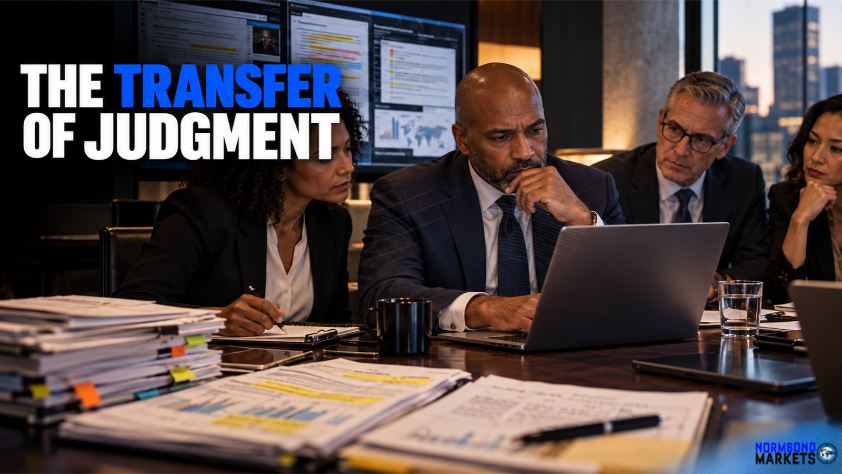

There is a sentence we are going to hear more often as AI moves deeper into consequential work.
“A human still makes the final decision.”
It sounds reassuring.
And in many cases, it is technically true.
The CEO approves the acquisition.
The investor allocates the capital.
The sales leader decides whether to pursue the account.
The doctor signs off on the treatment.
The commander makes the call.
The human still decides.
But that answer inspects only the last few seconds of a much longer process.
Because before a person makes a decision, someone has already decided what they will see.
- Someone has selected the evidence.
- Someone has removed what appeared less relevant.
- Someone has summarized competing views.
- Someone has ranked the options.
- Someone has estimated what might happen next.
- Someone has turned uncertainty into a briefing.
AI can now carry more of that work.
And that means final authority is no longer the only place we should look for judgment.
The decision can stay human while the judgment moves
We tend to locate responsibility at the end of the chain.
Who approved it?
Who signed it?
Who made the call?
That makes sense.
Organizations need accountable people.
But the signature does not tell you how the person arrived at the decision.
A CEO can retain complete authority while gradually handing over more of the interpretation that makes the decision possible.
The research arrives through AI.
The briefing is prepared through AI.
The competing evidence is summarized through AI.
The possible outcomes are ranked through AI.
The recommendation is shaped through AI.
Then the executive decides.
Nothing about that sequence requires AI to have final authority.
But something important has still moved.
The decision stays human while parts of the judgment used to reach it move elsewhere.
That is the handoff worth watching.
It rarely looks like a handoff at first
Most companies will not hold a meeting and announce:
“We have decided to trust AI’s judgment.”
It happens more quietly.
The first summary saves twenty minutes.
So the team uses another one.
The research comes back faster.
So less source material gets reopened.
The recommendation is reasonable.
So it becomes the starting point for the meeting.
The forecast keeps landing inside an acceptable range.
So more planning starts depending on it.
Nobody has declared the system authoritative.
It simply becomes useful enough that people begin treating its output as something they can safely build from.
Then other work starts depending on that output.
The summary becomes the record.
The briefing becomes the shared understanding.
The forecast becomes the number everyone discusses.
The recommendation becomes the option that has to be argued against.
And something has hardened without anyone calling it a decision.
The exposure gets harder to inspect once the organization has built enough around the output that questioning it threatens speed, revenue, commitments or competitive position.
At that point, removing AI is no longer the same thing as turning off a tool.
You are disrupting how the company now understands the work.
Success can create the exposure
Much of the AI-risk conversation still begins with failure.
What if the model hallucinates?
What if the answer is wrong?
What if the system behaves unexpectedly?
Those are real questions.
But they can distract from another condition.
AI does not have to fail to accumulate influence.
It can do it by succeeding.
Good summaries earn more summarizing.
Useful research earns more research responsibility.
Accurate forecasts earn more forecasting responsibility.
Strong recommendations earn more influence over the next recommendation.
Every successful cycle makes the next handoff easier.
That is how a capability becomes a habit.
Then the habit becomes an expectation.
Then the expectation becomes something other people build around.
Eventually, the more uncomfortable question is no longer:
“Is the AI accurate?”
It becomes:
What exactly are we still inspecting ourselves?
A public example makes the distinction visible
A recent TIME interview with President Donald Trump offered an unusually clear example of why this distinction matters.
The interview was conducted on September 28 and published October 1.
During the discussion about AI, Trump emphasized both the enormous economic and competitive value he sees in the technology and the responsibility of companies operating it.
He told TIME that companies “have to be responsible for yourself,” while also acknowledging that relatively few people fully understand what is happening with the technology. He repeatedly returned to the importance of keeping the United States ahead in the AI race.
TIME then asked what guardrail exists.
Trump pointed to the Department of Justice and FBI, saying that if companies “do bad things,” those institutions can respond.
There is a policy debate inside those answers.
But there is also a business question that sits one layer earlier.
Enforcement is not inspection.
Enforcement responds after a boundary has been crossed.
Inspection asks what was being allowed to carry consequential work before anyone knew where the boundary was.
What did the AI touch?
What started depending on its output?
What interpretation reached the person responsible?
And what had already become difficult to unwind by the time someone challenged it?
The hidden handoff is even easier to see upstream
TIME’s broader reporting around the interview described another revealing moment.
According to officials cited by TIME, Trump spent hours questioning Elon Musk’s Grok about his presidency and Venezuela.
TIME reported that he asked how Venezuelans might react if Nicolás Maduro were removed, and that the chatbot’s answer contributed to Trump’s impression that Grok was highly intelligent.
That does not establish that AI made a military decision.
It would be irresponsible to claim that.
But it demonstrates the distinction.
AI does not need permission to make the final decision before it can influence the environment in which that decision is made.
- It can frame the situation.
- Summarize the history.
- Estimate likely reactions.
- Select which signals appear important.
- Make one interpretation feel more plausible than another.
Then the human decides.
Technically, the human still made the call.
But that leaves another question unanswered:
What carried the interpretation that reached the decision-maker?
That question does not disappear because a human signed at the end.
The more useful AI becomes, the harder this gets to question
This is where the issue becomes more difficult for companies already getting real value from AI.
Early inspection is cheap.
Nothing important depends on the system yet.
You can challenge the output.
Reopen the source material.
Change the process.
Switch providers.
Remove the tool.
Later, the conditions change.
Customer expectations may depend on the speed.
Revenue may depend on the workflow.
Employees may have been hired around it.
Products may promise capabilities that require it.
Board forecasts may assume its output continues.
Budgets may have already moved.
Leaders may have publicly committed to the economics.
Now questioning the AI is no longer a technical exercise.
You are questioning decisions people have already defended.
The more valuable the system becomes, the more expensive it can become to ask what we have allowed it to carry.
That is why the important moment may not be when AI receives formal authority.
It may be earlier.
When its output becomes difficult not to use.
The Interpretation Gap appears before the signature
This is where I locate what I call the Interpretation Gap™.
It does not begin when AI gives the wrong answer.
It can begin when the person responsible for a consequential decision can no longer see clearly how the information in front of them became the interpretation they are being asked to act on.
Those are different questions.
Decision authority asks: Who gets to make the call?
AI Judgment asks: What shaped the version of reality they used to make it?
That distinction makes the problem inspectable.
Look at a board briefing.
An acquisition recommendation.
A customer-risk score.
A credit decision.
A diligence report.
An account summary.
A hiring recommendation.
A market forecast.
Do not begin by asking whether AI made the decision.
Ask what AI had already selected, compressed, ranked, excluded or interpreted before the decision reached a human.
Then ask how often anyone still reopens that work.
Because that is where influence can accumulate long before authority becomes visible.
Four questions before the decision hardens
For any consequential decision being made from AI-prepared information, I would want four things made visible.
- What consequential decisions are now being made from AI-prepared information?
- What did AI select, compress, rank or interpret before that information reached the decision-maker?
- What part of that interpretation has become routine enough that nobody reopens it?
- If the resulting decision becomes expensive, who has to defend it?
None of those questions require AI to have final authority.
That is the point.
AI can carry preparation without carrying the final decision.
It can carry interpretation without carrying legal responsibility.
It can influence what feels reasonable without ever receiving permission to decide.
And eventually, a human can be completely responsible for a decision assembled from a version of reality they did not fully construct.
Before asking what AI should be allowed to decide, inspect what it is already allowed to tell the people who decide.
Final authority is not the only place judgment can move.

Norm Bond
Latest posts by Norm Bond (see all)
- How Much of the Judgment System Should AI Be Allowed to Shape? - October 16, 2026
- The Transfer of Judgment: When AI Shapes the Decision Before the Human Makes It - October 4, 2026
- Your AI Adoption May Be Moving Faster Than Your Ability to Inspect It - September 21, 2026
